
Türkçesini okumak için: https://emrenurbeyler.com/2023/10/25/donaueschingen-muzik-gunlerinde-next-generation-1/
I caught the 08:50 train to Donaueschingen holding a Saatenbrötchen (my favorite) in my left hand. Next gen is using the hall of Heinrich-Feurstein school in Donaueschingen as their HQ; everything next gen related happens in the hall of this school.
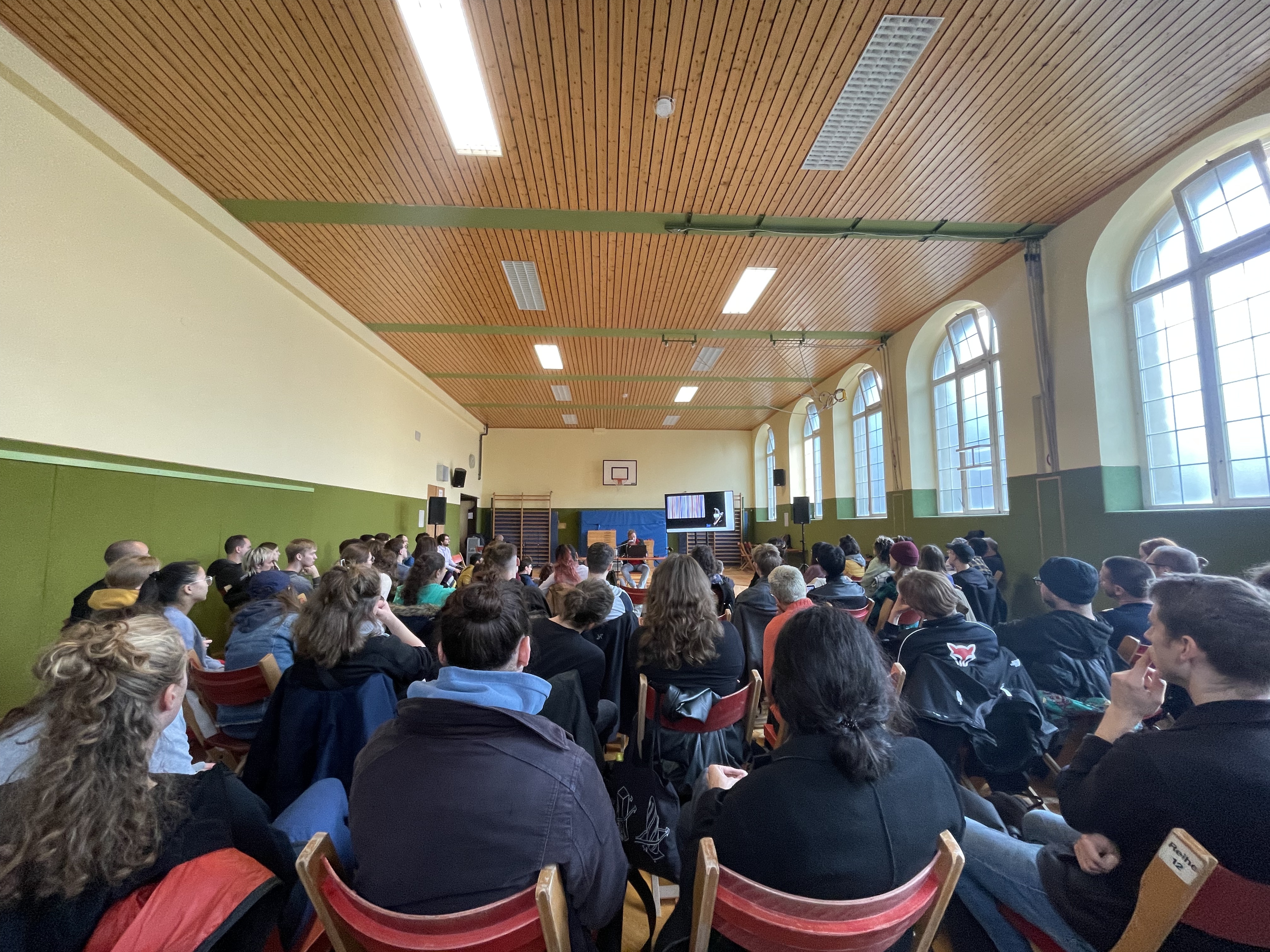
Heinrich-Feurstein Hall full with the 100 next gen students.
Svetlana Maraš: Designing a live electronic instrument
First lecture of the day was given by Svetlana Maraš. She’s known for her concerts where she appears with live electronic instruments that she’s designed herself. Instead of the academic POV she focused on her own experience regarding the subject; and she explained in high detail so one could say her lecturing relied on our observation skills. She had this setup in front of her, with which she could send the computer detailed MIDI messages of how hard, how long, and where exactly she was pressing on the control surfaces. An iPad positioned in the middle acts as a control center to change the sound of the surfaces.

Maraš’s ‘instrument’. On the right you can see the screen set up with a close up camera for us to see everything more clearly.
Maraš’s teachings were very valuable. If you aim to design a sound in digital environment, her recommendation is to instead design the very ‘instrument’ first. We can change the timbre of a sound by playing with its parameters; and putting the work of designing the way we play with these parameters (that is, the ‘instrument’) upper on our to-do list pushes us to a more organic path of developing a sound. If we imagine the creation processes of todays common acoustic instruments like flute, violin and guitar, it wasn’t like the inventor dreamt of a specific sound and created an instrument around it. The instrument defines the sound, the sound defines the piece. By creating your instrument, you define your piece.
She also had great advice for spatial composers. It is common for spatial compositions to have short bursts of sound, but it may be hard for the audience to figure out where from the room these sounds are coming from because of their brief duration. Her solution is to put some noise right before the burst (or with the burst) to turn the audiences heads to that direction. Cool!
By the way it was very funny to see Research Head of Department of Basel University Mr. Kunkel turn the PowerPoint pages for Maraš. What a friendly atmosphere! ♥️
Johannes Kreidler: Music as Statement
Kreidler talked about various projects he’s worked on until today, and the reception/reactions he received on his 1 hour long seminar. Kreidler is a smart man; in terms of how the society may react to what, he has all the answers and is willing to use this knowledge in favor of maximizing the impact of the statements he desires to make via his art.
For example, in his piece Product Placement (2008) he successfully draws the attention of the world press to the controversial copyright laws by using samples from 70,200 copyrighted songs and attempting to claim rights to this ‘new’ work:
On his work Earjobs (2011) he forcibly pays people to listen to music and explores the possibility of money affecting the entertainment received. If you’ve noticed there’s no ‘piece’ in a traditional way here, the piece is the very idea and action; it is music as social experiment.
Other interesting examples of Kreidler’s works: Two pieces for Clarinet and Video:
Exhibiting various concepts from life with music notation:


I could sit here and talk an hour about Kreidler’s works, which is exactly what he did in his seminar. He didn’t talk much more than that; it’s safe to say that he trusted our observation skills to do the rest. It made me think a lot; from my POV it was a successful seminar.
Kreidler took some students who wanted to work with him when he was going. They are going to work together on writing an artsy manifest throughout the duration of next generation. They’ll be presenting their work on Sunday, the last day of the festival. Let’s see how they’ll do.
Carrasco: Spatial audio

Last seminar of the day was by Prof. Teresa Carrasco about spatial audio. This really was a great seminar, but I have to say I personally didn’t learn much from it because it’s about a subject I’ve been particularly interested in for the last times. She spoke about different techniques and history of spatial audio, which is taught extensively by our dear Prof. Joachim Goßmann in the Music University of Trossingen every week. You can read my previous blog post about my spatial audio exploration here: https://emrenurbeyler.com/2023/06/13/project-bach3d/
She showed different sound dome applications from USA, Canada, Germany and more. The students listening also gave examples from other places, like Israel. I distinctly remember thinking “Wow that’s a lot of sound domes”! It felt like the climax of the Avengers: Endgame movie where the small group of heroes are saved by other heroes arriving from around the universe saying “I’m also here”. Trossingen is definitely not the only place in the world busy with spatial audio chambers and that’s fantastic. After the seminar I invited Carrasco to visit Trossingen and see our progress with spatial audio. I really hope she does visit; I think she’s a very valuable teacher regarding this subject.
Blecharz: Wireless speakers? A symphony??

Can Boerescu, Selim Kılıçarslan and me in front of Erich-Kästner Hall
Composer Wojtek Blecharz from Poland has been known for his “safe space” music for a while now. He likes to compose pieces that are meditative and comfortable experiences. It is a recurring theme in new music concepts to not just compose notes and call it a day, but to craft a full experience package for the audience by thinking of every aspect a listener might interact with: what they see, what they hear, where they sit, what they do, how they listen, and so on.
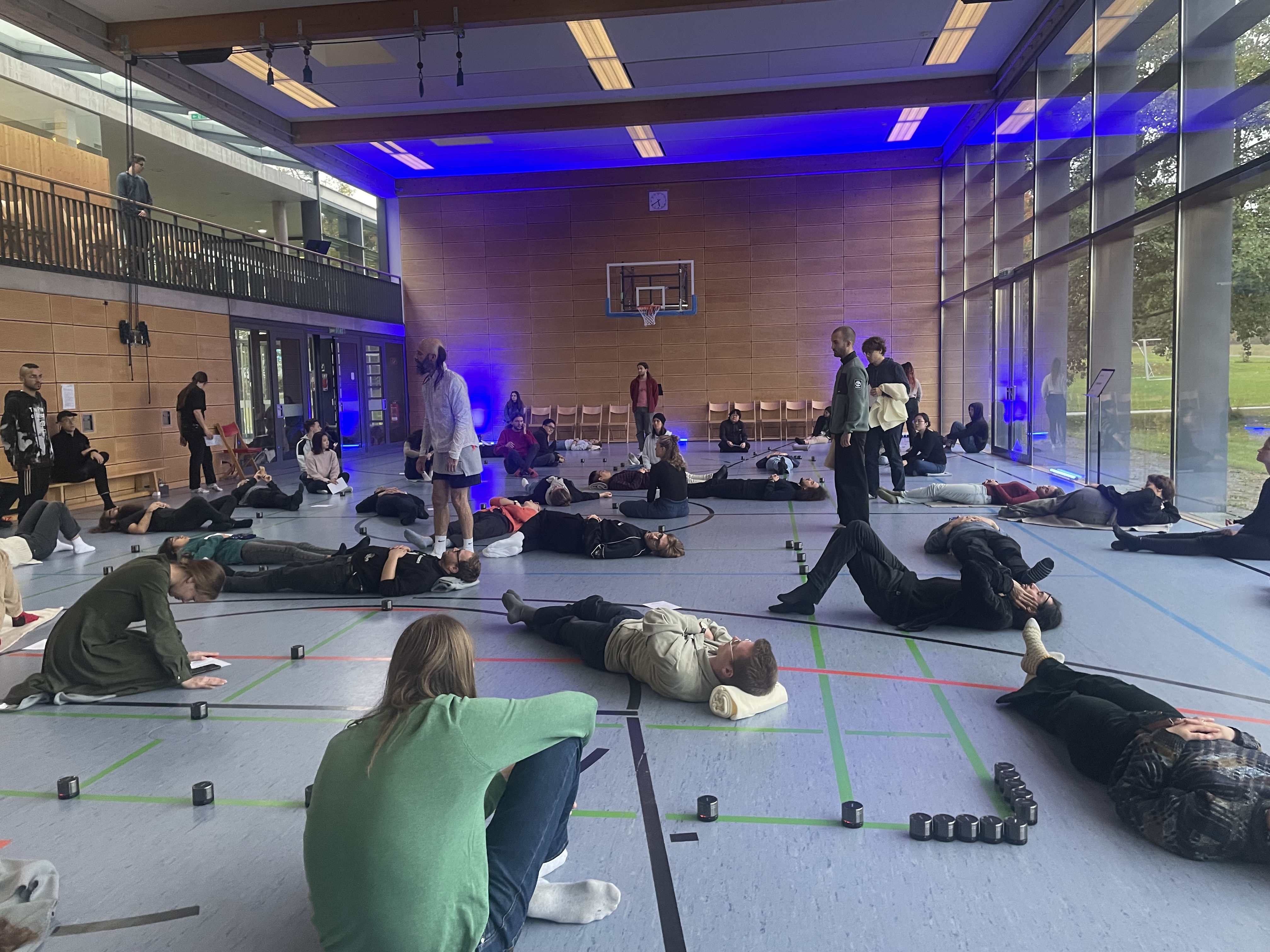
Next Generation students experiencing Blecharz’s Symphony No. 3 in the Erich-Kästner Hall
Blecharz’s newest Symphony No. 3 has all its tickets sold out, but I’m thankful to the next gen organization team for arranging the general rehearsal to exclusively play for next gen students.
This is a piece written for 220 wireless speakers and (almost) nothing else. On some places there were short acoustic performances, but the piece is mostly played by these puny little speakers. A single one of them could barely reach levels of mediocre laptop speaker loudness, but cramming 220 of them in a sport saloon does a fantastic job at creating that immersive sound. We were all positively surprised!
They each had numbers on them to identify, and the composer Blecharz (that’s the bald guy wearing white socks and sport outfit) acted as a performer by constantly moving the speakers as planned and initiating meditative, droning sounds from them, one by one, by hand, in a specifically planned manner. This was arguably the best way to synchronize 220 wireless speakers; by playing sounds that don’t need perfect synchronization to combine. He said in his instagram that he squatted 600 times in one day because of this performance!
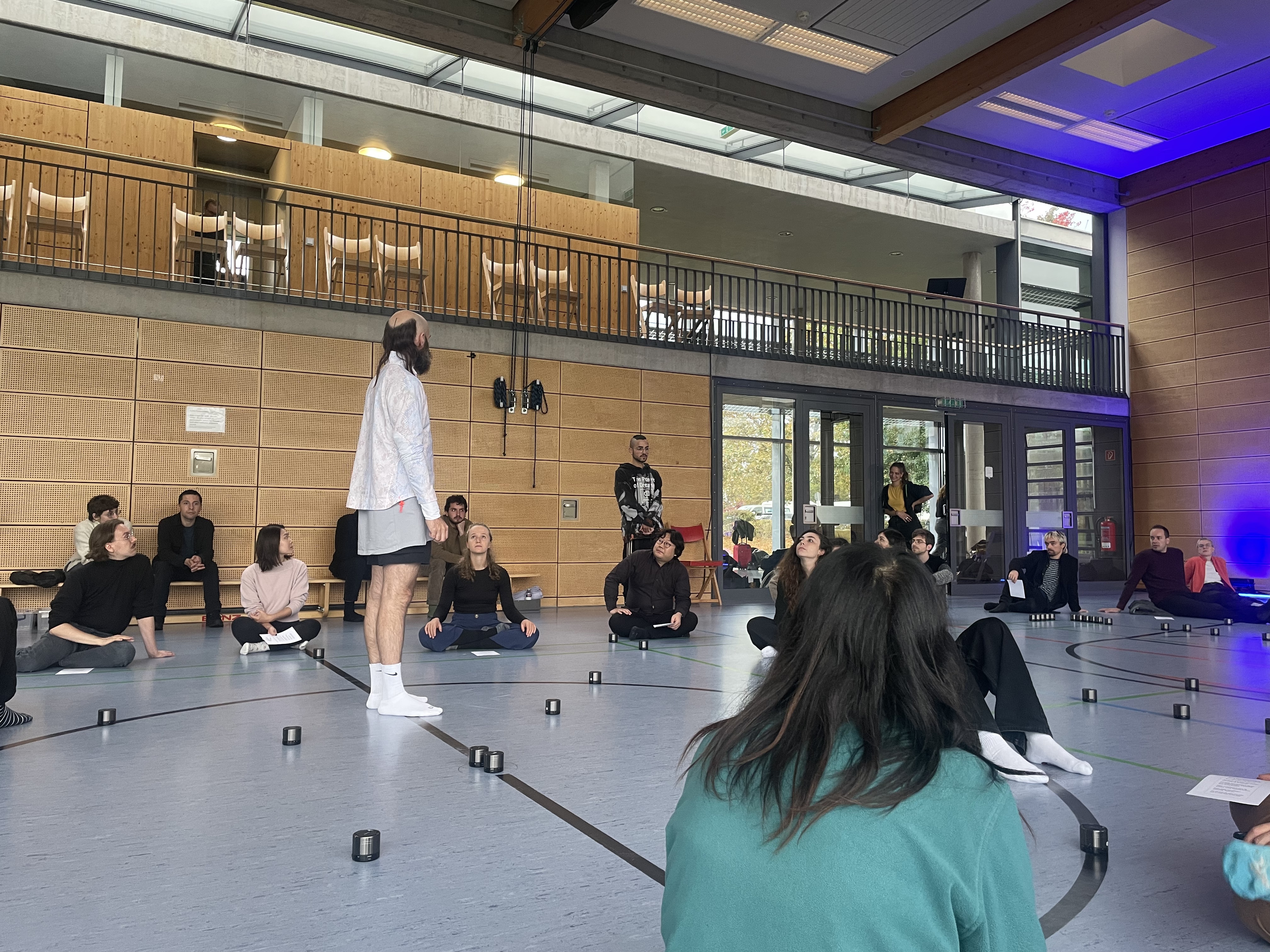
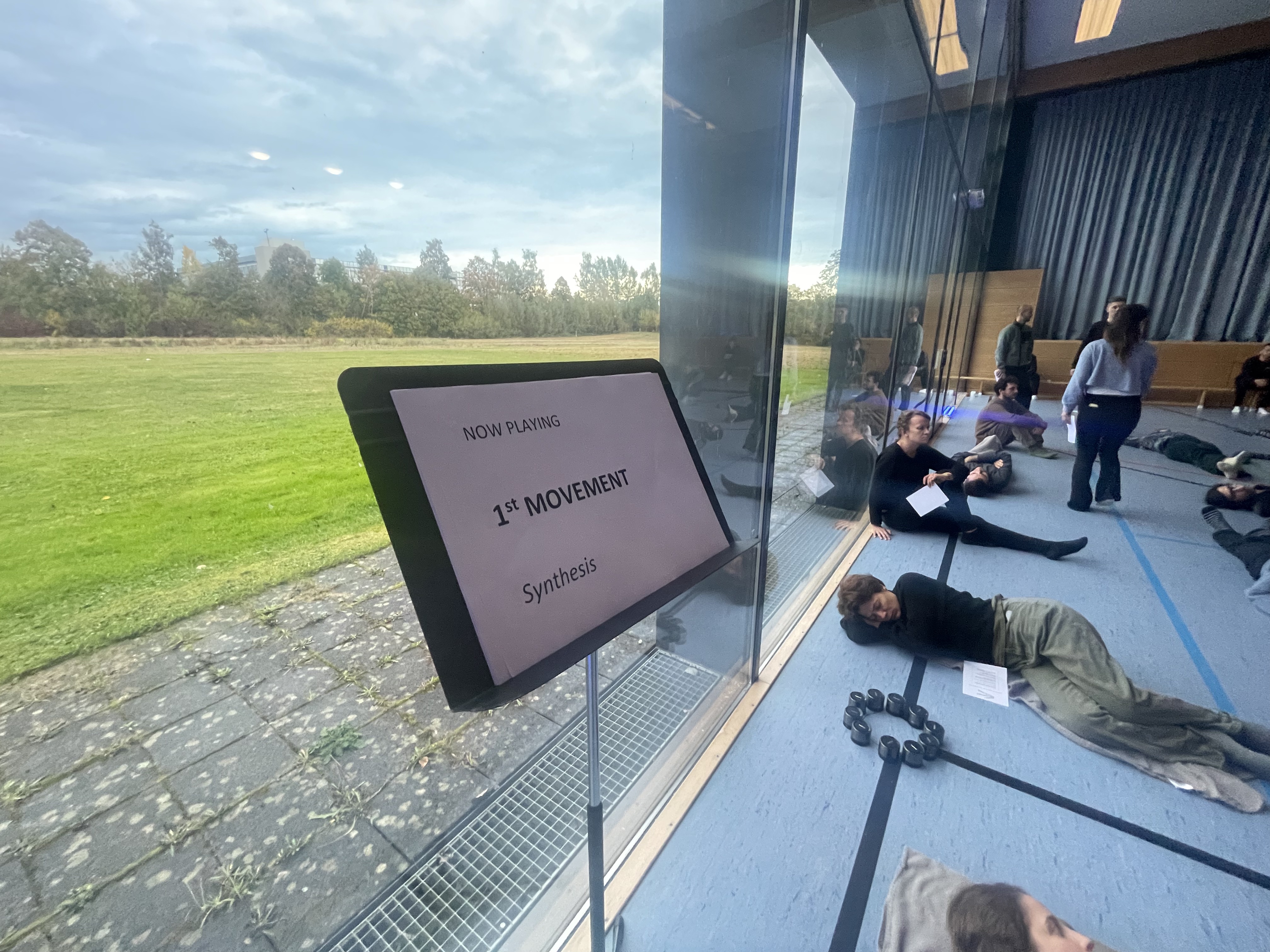

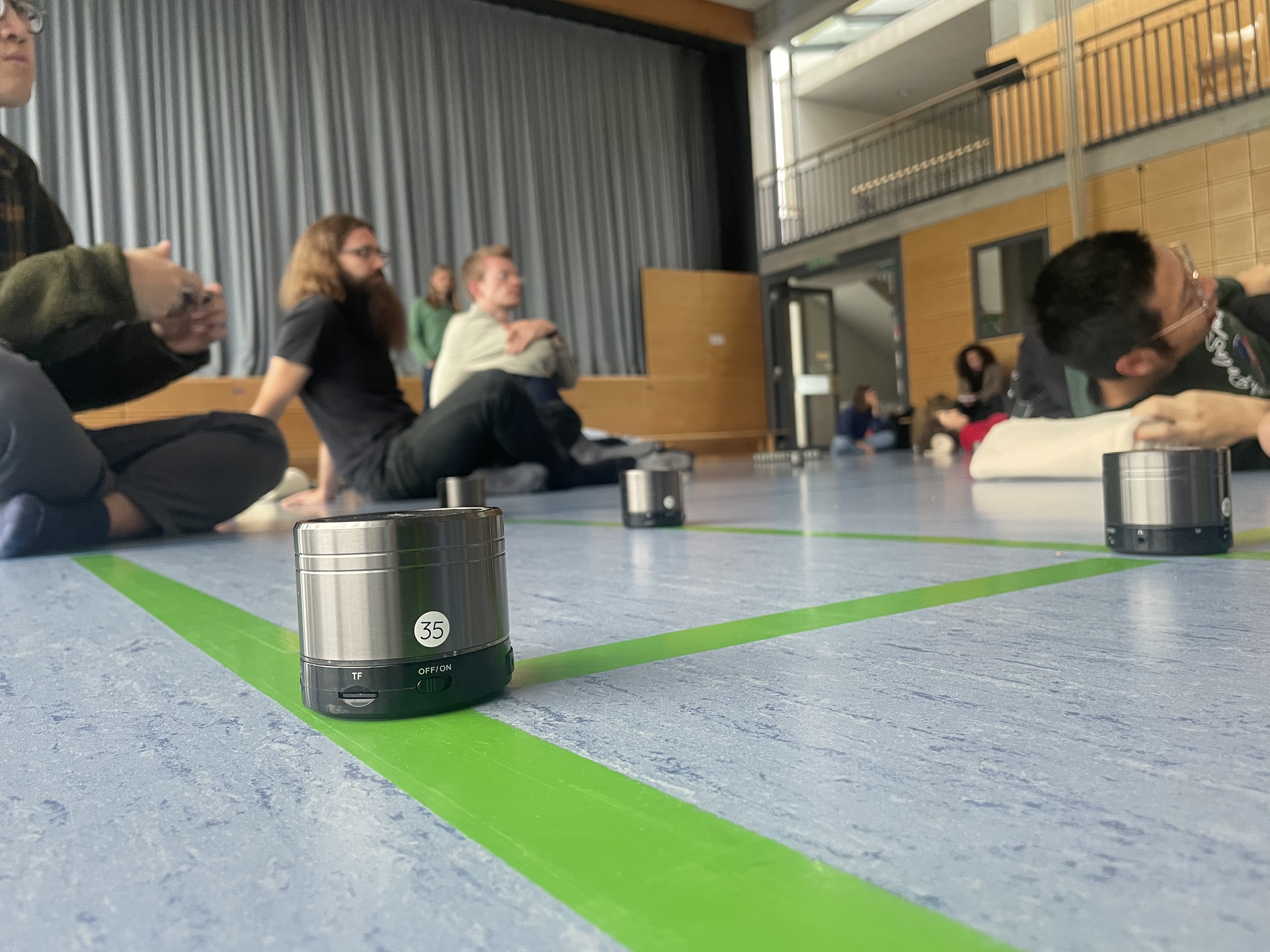
I’d say he did succeed on his mission of making a meditative experience.
 Piyano Bloğu | Emre Nurbeyler
1 comment