
Development of an innovative concert concept, 01/02/2024
Trailer and full concert video on the bottom of the page.
At the end of October 2023, my friend and colleague, Sofia Baptista Torgal, invited me round for a cup of tea to tell me about an idea she’d had for some time. Her boyfriend’s job is to manage the sustainability aspects of a larger company; she was very impressed by this and wanted to do something similar with her own resources. She also said that Dominik “Dome” Rösler was also involved in the project, which made me very happy as he is one of my closest friends here in Trossingen. The idea was simple: to find a way to get people to care more or do more about the climate crisis.
Goals
We have all seen countless means of expression in every form trying to draw attention to the problem of the climate crisis. Our goal as Inner Decision was not to be another one of those, but to go a step further and actually move something in people to get them to act. This would prove to be much more difficult, but music happens to be one of the most powerful forms of expression ever.
I was on the phone with a good friend who studies climate science at Yale University in the US. Her key advice was that the solution to the climate crisis lies not in daily sacrifices like using paper straws, recycling, etc., but in society’s decision-making bodies, like parliaments or city councils. Creating a concert experience that makes people feel like they are making a choice or putting them in the shoes of the people we all so often blame.
We prepared this project for the university’s internal competition “Innovative Concert Formats”, which also served as a pre-selection for the nationwide competition D-Bü 2024 with the same theme.
Brainstorming
From October until the day of the concert, we had countless Zoom and café meetings to discuss our concept. These were crucial meetings that allowed us to clearly recognise our abilities and limitations, develop our ideas together and agree on a common end result.
We naturally wanted something that would appeal to the audience. I thought back to the quote from Apple founder Steve Jobs: “Instead of inventing something and thinking about how to market it, think about a user experience and work backwards to discover the technology you need.” I treated this project very pragmatically as a product that we wanted to serve to the audience on concert day. We had a certain amount of time available and we had to make the best use of it.

Me in Turkey, brainstorming with my group via Zoom
Synesthesia, Chromesthesia and Poem
The division of the piece into 6 sentences was originally a pragmatic way of organising our thoughts. We chose a colour and two or three main feelings or concepts for each movement and brainstormed about each movement in this way. We agreed to compose original music as well as use excerpts from well-known pieces to reinforce the associations between the music and the concepts. We also added some LED lights in the corners of the room to make the whole room the corresponding colour. Lastly, Dome and I wrote a poem together in English with 7 verses. Each sentence got its own verse, and together they would tell the story of life on earth. In the end it was like this:
I. Blue
- Concepts: Ocean, rivers, rain
- Represented by: Water
Beneath the azure sky, where rivers gently weep, A tale unfolds in nature’s cradle, secrets to keep.
II. Green
- Concepts: plants, forests, birds, wind
- Represented by: a tree leaf
In the verdant embrace, where forests weave their lore, Life dances in the shadows, a vibrant encore.
III. Light Gray
- Concept: Man in harmony with nature (hunting and gathering or agriculture)
- Represented by: a stone
Amid the twilight grays, humanity did blend, A thread in nature’s tapestry, hand in hand.
IV. Dark Gray
- Concepts: Man in disregard of nature (Industrial Revolution)
- Represented by: a spanner
Yet shadows grew darker, as disregard took hold, Harmony disrupted, a narrative of untold cold.
V. Orange
- Concepts: Earth takes back control, uninhabitable conditions
- Represented by: a bloodstained bone
A somber palette emerges, as orange hues ignite, The planet takes control, reclaiming its might.
VI. Red
- Concepts: Total destruction, fire, death
- Represented by: Fire
Beneath the crimson canvas, a requiem unfolds, Total destruction, where silence takes hold.
Coda. Darkness
- Concept: Hope; reminder that this timeline is avoidable
A tale ancient yet poignant, of a planet’s plea, Cherish the Earth, or face a destiny we decree.
One evening I asked my good friend Sebastian Gwilt, a native English speaker, to come over and record the poems at my house. This made me appreciate my Zoom H6 recorder again.
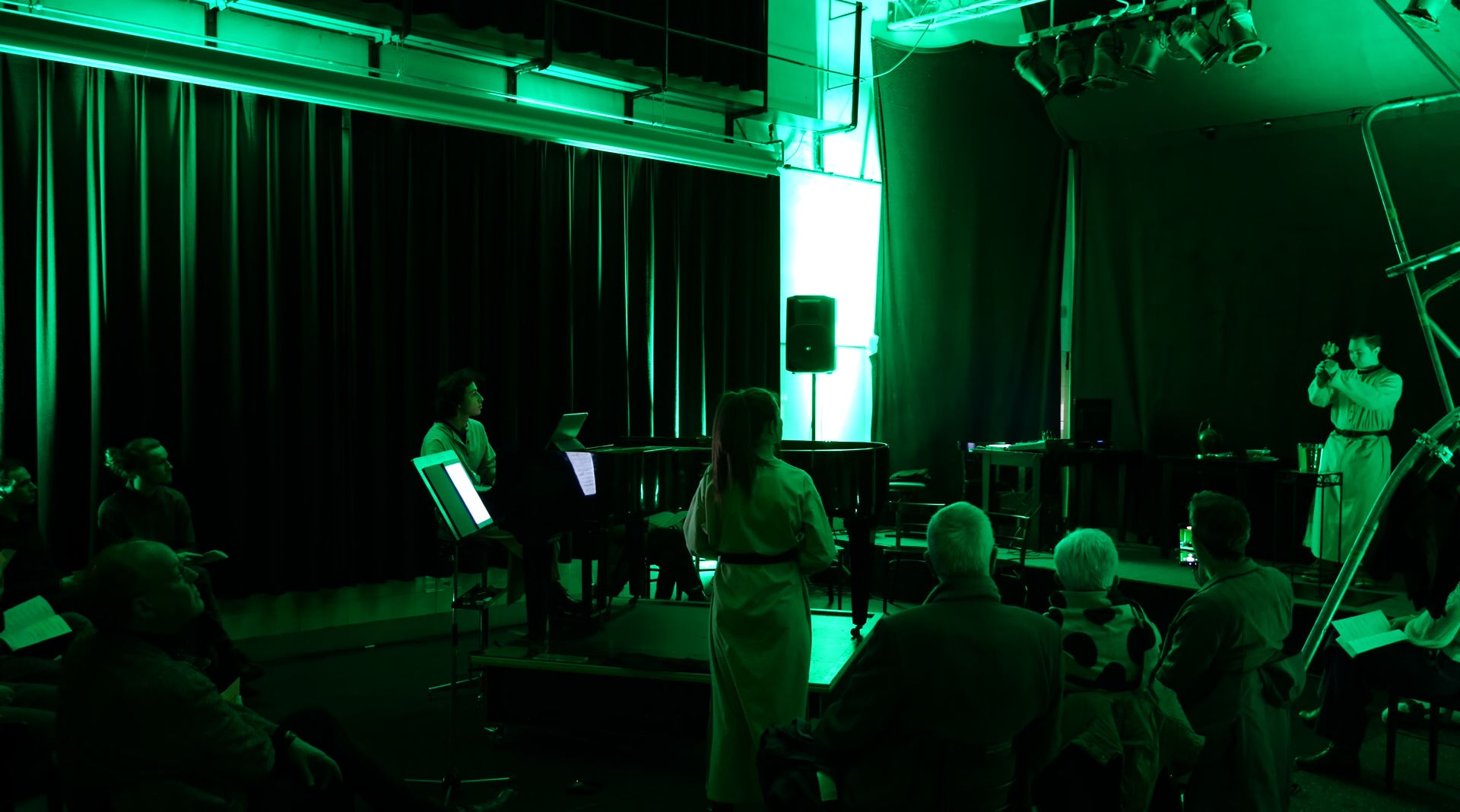
The room is covered in green colour. You can see Dome on stage placing the leaf in the bowl filled with water.
Bowl
During our brainstorming session, we had the idea of placing the representative object of each movement in a glass and changing the glass between movements. And then came the big idea: what if we put everything gradually into one bowl and burn it at the end? If it were just me, I would never let that happen because it could be so exhausting, time consuming, distracting and dangerous, but my group was adamant and democracy won out. Looking back, I’m amazed at how well Sofia managed it, because in the end everything worked out perfectly.
At the concert, we had the bowl on stage near Dome so that he could walk and put the object in it. I also arranged the music so that everyone had at least one opportunity to perform the ritual of putting objects in. We also played the appropriate poetry readings while this action took place.
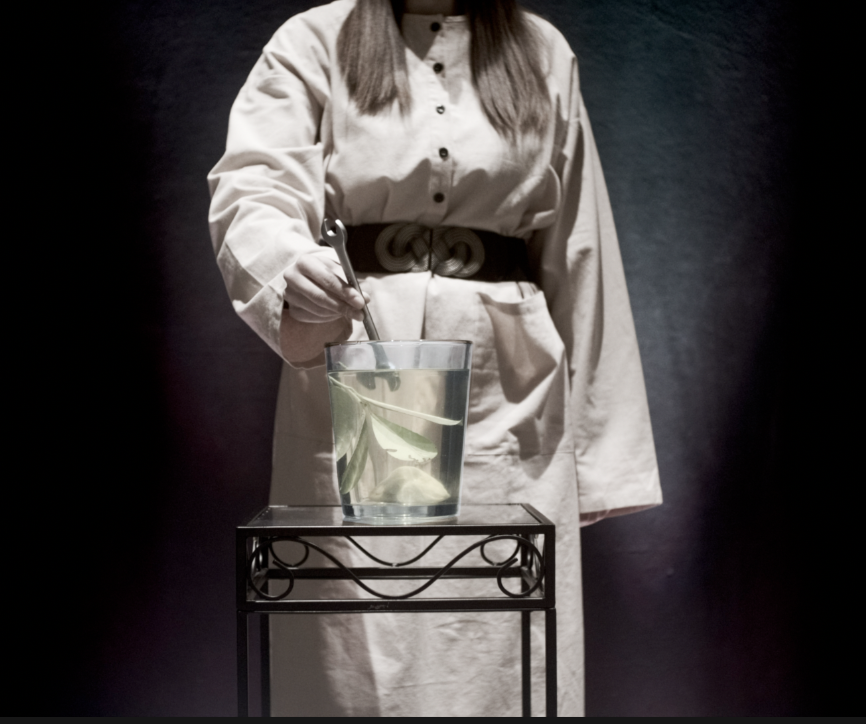
Sofia places the spanner in the bowl in IV. Dark grey
Voting & Deciding
One of the most important parts of our piece was that we asked the audience three times during the piece to choose between two imaginary situations and thus change the course of the piece of music. We placed the piano not on the stage but in the centre of the audience and placed the chairs in a circle to enhance the tribal feeling and really give the experience of coming together to make a decision. People would cast their vote by raising their hand and showing either a closed fist or an open hand. This process was explained to the audience in the program.
For each possible outcome, I composed two different versions of music and we practised and prepared them. e.g:
III. Light Gray
✋ after a few seconds of the movement, I get up from the piano, start to walk around the room and explain the situation: “You find yourself in Northeast Asia, camping in front of a mountainous landscape as part of the Yamnaya tribe. You are faced with the difficult decision of either remaining hunter-gatherers or settling down and farming. Which one is it going to be? Vote with your hands.”
- If they choose hunter-gatherer, fast music is played, symbolising the adrenaline-fuelled chase, followed by slower, calmer music representing the gathering part.
- If they choose farming, music based on the chants of the Black Sea people will be played, representing the harsh conditions of working on a farm.
I have tried to use similar musical elements, but framed in a different context, to minimise the effort involved in practising.

Voting process in concert
Music
I used my usual Dorico notation software to compose everything directly on my computer. Everyone kept track of the score via iPads, which made distributing newer versions very easy.
The music is a mixture of original compositions and quotes from other pieces. The piece has the main theme Hu-ma-ni-ty (B, A, E, F#), which serves as the basis for almost everything.
I. Blue
I juxtaposed scales and effects from pieces by Debussy and Ravel to evoke different types of water; long lines for rivers and smaller drops for rain. The electronics played the sounds of the rivers and the rain with dynamics that matched the music. The movement symbolises the absolute balance of the world, which is dominated by moving water.
II. Green
I analysed Messiaen’s Catalogue d’Oiseaux to see how he translates bird calls into well-tempered pitches. I transcribed some of them into a rhythmically identical (like the sixth movement of his quartet) duo between oboe and piano, which was difficult but very rewarding. A long solo of the reed warblers from his catalogue was played in this way. There are also some pieces by Debussy and Beethoven’s Pastoral Symphony.
III. Light Gray
Here, the arrival of mankind is depicted with consonant music as part of nature, where it lives in harmony with its surroundings. As I have already explained, two different pieces are played here depending on the voting.
IV. Dark Gray
The metallic-industrial repetitions in George Antheil’s Sonata Sauvage were perfectly suited to this movement.I simply arranged it for oboe and piano and made some parts shorter and longer. Towards the end, the piece takes on a Stravinsky-like approach with hypnotising ostinatos and continues in a downward spiral symbolising man’s endless desire for consumption and exploitation.
V. Orange
This movement, which is strongly inspired by Stravinsky’s Le Sacre, shows how the earth finally takes control again and wreaks havoc on its hostile inhabitants. Many rhythmic beats and dissonant trills are used.
VI. Red
There is no written music for this part, which signifies total destruction and the aftermath devoid of everything we take for granted. The electronics play tribal drums, the piano plays dissonant intervals that are muted with the fingers, and the oboe plays long, haunting notes. The whole movement is improvised.
Coda. Darkness
Sofia runs up the stairs and plays III. Niobe by Britten: Six Metamorphoses from afar. The audience only hears the echo of the oboe, which means that this future is only a possibility and that we still have the power to change it.
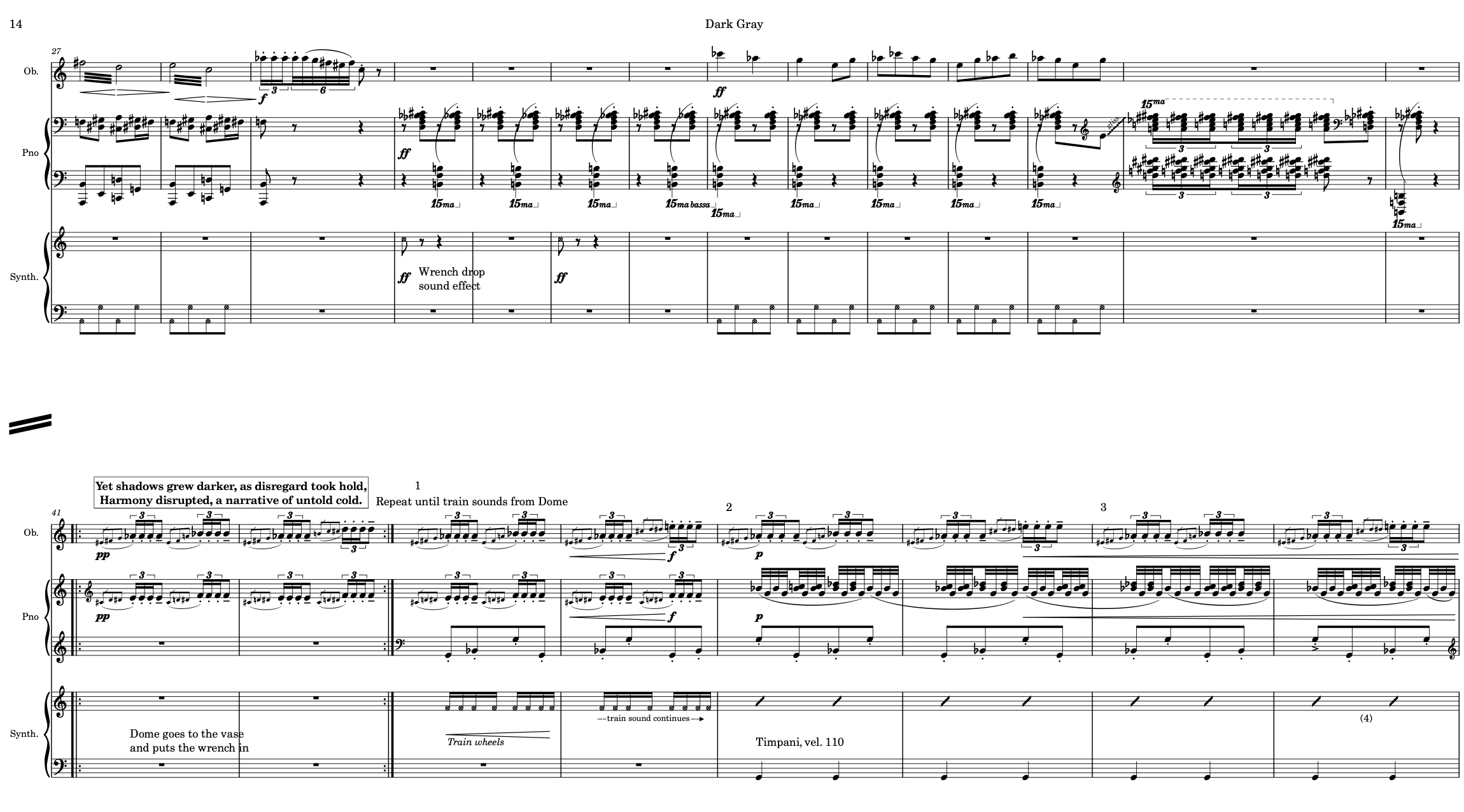
A page from the score
Division of labour
We didn’t think about what the individual roles should look like from the start; it just turned out that way the more we worked on the project. Everyone focussed on their area of expertise and did as much as possible there.
Sofia
Sofia was fully in charge of the bowl, which is very difficult because most of the “ritual” depended on it and our expectations were high. On top of that, there was real fire involved! Sofia handled it all very well; she experimented with different liquids and materials. At one point a fireman inspected our work and deemed it safe, which was undoubtedly the result of Sofia’s hard work.
She was also responsible for ordering the clothes we had decided on and took care of all the paperwork involved in registering for the competition, speaking to the rector’s office, filling out forms and so on.
Dome
Dome was responsible for every sound that wasn’t acoustic. He found or developed sound effects for all kinds of things, took care of the spatial quadraphony and sometimes joined us as a chamber musician with his synth keyboard. He also took care of setting up and dismantling the electronics in the Kesselhaus.
Emre
I focussed on composing the piece along the lines that we had drawn together. I also took care of the promotional work, such as preparing, printing and publishing the posters and programmes.

Program booklet of the concert evening
Advertising
Since I was born, my parents have owned and run an advertising agency (an old-fashioned, print-based agency). My mum does the design and my dad does the ‘field work’ (talking to clients, printing and installation etc). Over the course of my life, they’ve taught me a lot about their work, so much so that I could do either if I really wanted to. For years I’ve been designing my own concert posters, taking my own photos, writing my own programmes and knowing the types and thicknesses of paper and everything that goes with it.
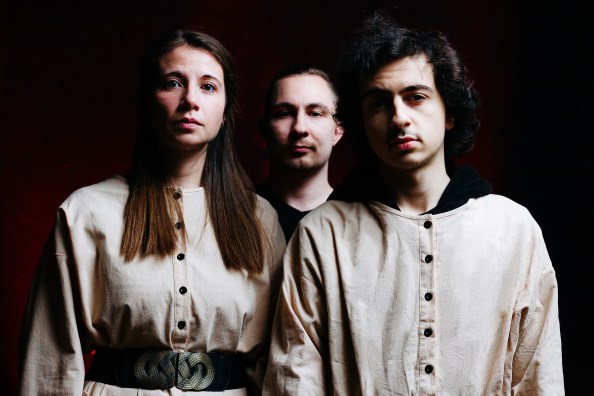
With this in mind, I have happily taken on anything to do with advertising. The first layer was, of course, to tell our friends about it and to invite them at every opportunity. On the day of our first general rehearsal, we asked Emanuel Werres and Sonja Schmid (who were the only audience) to take some artistic photos of us in our tribal clothing. I then edited one of these pictures in Photoshop using a gradient map to change the colours artistically and also used the golden ratio to distribute the high-contrast subjects of the picture in an appealing way. I also made sure to use the university’s format (date and location at the top, a narrow band on the left, logos, etc.).
Once it was ready, I got my group’s approval and printed it at school using the A3 colour printing function of the photocopier foyer, which not many people know about. I hung around the school and also reserved one for my room.Then I also prepared a 1:1 square version of the same design for social media and posted it along with a little caption: “Inner Decision invites its audience to a post-apocalyptic tribal ritual dedicated to rising waters and angry weathers.”
After our concert, I booked Jonas Šopa, who is a great photographer (and a good friend!), to do a professional photo shoot of us in the Kesselhaus. We already had some good photos, but I thought it was worth getting some professional photos as well.We ended up using them for our application for D-Bü 2024. I also created a video trailer using Final Cut Pro on my laptop, using the footage from the concert and some short videos from the bowl action. It took me about a day to edit it and synchronise it with the sound.
Rehearsal Calendar
12.01 Friday
12:00 – 19:00 at the Kulturfabrik Kesselhaus
This was our first real rehearsal where we had (almost) everything in place. We used the time for general work, played with long-sleeved clothes, marked the places for the music stands, burnt the shell for the first time on the spot, etc.
13.01 Saturday
14:00 – 18:00 in the Hans-Lenz Saal
We used the Hans-Lenz Saal for our rehearsals when we didn’t have access to the Kesselhaus because of its technical equipment. It was often used by other groups taking part in the competition. This rehearsal was for Dome and I, where we worked out all the kinks of the electronic part and prepared it for playing with acoustic instruments.
14.01 Thursday
14:00 – 18:00 in the Hans-Lenz Saal
Here we did the first (almost) complete run-through of the piece. We were also able to reserve more time for artistic practice instead of dealing with logistics.
15.01 Monday
12:00 – 13:00 in the Hans-Lenz Saal
15:00 – 18:00 in the Kulturfabrik Kesselhaus In literally the last few minutes of the concert, we played the piece from beginning to end for the first time. I’m still glad that there were no unexpected surprises during the concert.
18:00 Performance! at Kulturfabrik Kesselhaus
We were of course delighted to hear the news that we had won first prize. We invested a lot of our time and effort, and it was also a lot of fun. It was also a great experience and a masterclass in organising something like this from scratch.
Inner Decision – Trailer
Inner Decision – Full Video
 Piyano Bloğu | Emre Nurbeyler